
Women’s History Along the Erie Canal
The Erie Canal is undoubtedly a major shaper of NYS, and American, history.
Not only did the Erie Canal transport goods and supplies for the growing nation, it was also a pipeline for developing ideas and social reform. Seneca Falls, now recognized as the Birthplace of Women’s Rights Movement, was connected to the Erie Canal via the Cayuga-Seneca Canal, which parallels Main Street.
A dedicated abolitionist passionately opposing slavery, Lucretia Mott traveled all the way to London for the World’s Antislavery Convention, only to find that as a woman she was denied participation. So when she met Elizabeth Cady Stanton, a resident of Seneca Falls who had earlier worked on women’s property rights reform, they organized the first Women’s Rights Convention in July 1848. Joined in their organizing work by three other women living near Seneca Falls, the first Convention welcomed 300 men and women to discuss the radical idea of women's equality.
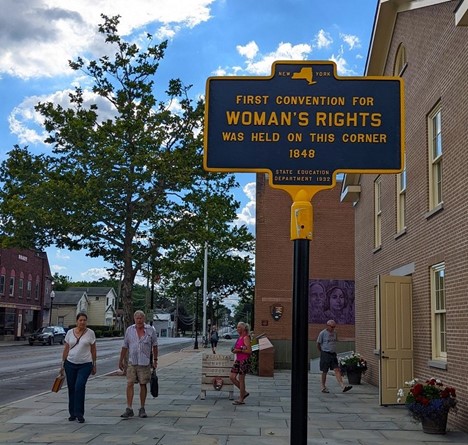
Seneca Falls and the country honors their achievement at the Women’s Rights National Historical Park, which hosts a Visitor’s Center & Museum next to The Wesleyan Chapel where the extraordinary two-day convention took place. A 100 foot long bluestone water feature, inscribed with the groundbreaking words of their Declaration of Sentiments, memorializes the important impact of the convening. The Women’s Rights National Historical Park is only a mile from where Cycle The Erie Canal will camp overnight, easily walkable or bikeable.
Seneca Falls continues to recognize women’s contributions in the National Women’s Hall of Fame, located directly across the Cayuga-Seneca Canal. Last year Hillary Clinton inducted nine amazing women, either living or alive in memory, into the Hall of Fame, which is housed in a former knitting mill that refused to process cotton as a direct protest to slavery.
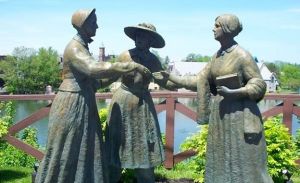
A short walk from the Women’s Hall of Fame is a statute entitled “When Anthony met Stanton.” It captures the moment three years after the Convention when Elizabeth Cady Stanton was introduced to Susan B. Anthony following an anti-slavery meeting. Together the two would spark the nationwide women's voting-rights movement.
Of special interest to bicyclists may be the woman who introduced them, Amelia Bloomer. Bloomer was a proponent of shorter skirts and full length pants gathered at her ankles. Definitely controversial at the time, the “bloomers” she popularized made the developing pastime of bicycle riding much safer for women to participate in.
Years after the famed meeting, Susan B. Anthony would write, "I think [the bicycle] has done more to emancipate women than any one thing in the world. I rejoice every time I see a woman ride by on a bike. It gives her a feeling of self-reliance and independence the moment she takes her seat; and away she goes, the picture of untrammelled womanhood."
If you are interested in learning more about the storied and impactful history of women along the Erie Canal, consider joining this year's Cycle the Erie Canal, taking place from July 9th to 16th and riding from Buffalo to Albany. Or, use our interactive map to plan your own trip.
Bloomers entirely optional.