
What Was Here? Explore Mysteries in State Parks
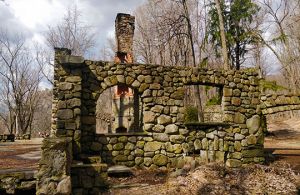
Our state parks contain many curious features that often elicit the question, “What was here?” Over the years, state parks staff and dedicated individuals from Friends groups have taken the time to identify and research the stories behind these evocative features. Sometimes, this history is imparted through interpretive signage or programming. Yet many of these remnants from the past exude an air of mystery that causes visitors to scratch their heads in bewilderment.
BANNERMAN CASTLE ON POLLEPEL ISLAND
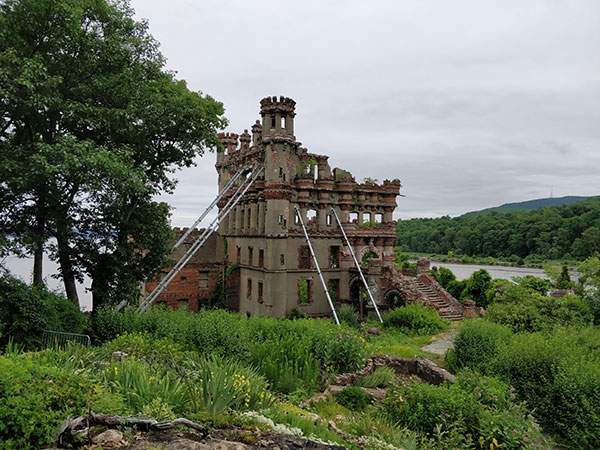
Anyone who has sat on the river side of an Amtrak train traveling between New York City and Albany has likely gazed in wonder at the stone ruins emerging from an often foggy island in the Hudson River just south of Beacon, wondering if they are seeing a mirage. Quite the contrary. The site is owned by the Office of Parks, Recreation, and Historic Preservation and is run by the Bannerman Castle Trust, Inc., a Friends group that has been actively fundraising for the site's preservation and operating seasonal public tours.
State Parks took over the island in 1999, after the Bannerman family from NYC , who had built structures as storage for their military equipment business as well as a house for a summer residence., abandoned the site. Ten years later, a non-profit organization was formed to preserve and provide access to the island.
For more about the history of Bannerman Castle and to schedule a tour or buy tickets to one of the many events staged on the island throughout the warmer months, including movie nights, farm-to-table dinners, and theater performances, visit: www.Bannermancastle.org.
CORNISH ESTATE IN HUDSON HIGHLANDS
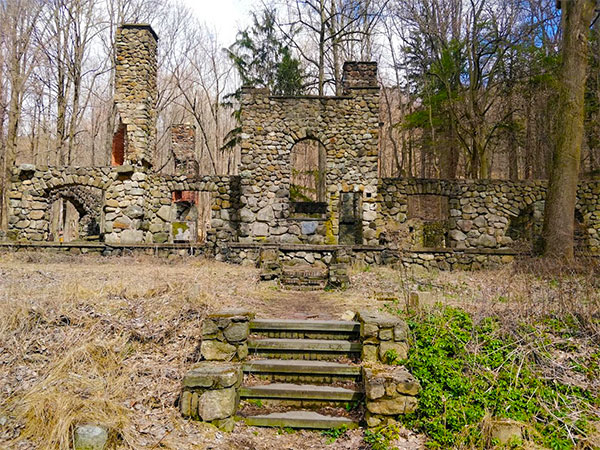
A short detour from one of the many busy Hudson Highlands State Park.trailheads along Route 9D just south of Beacon will reward a hiker with a surprise. “Northgate” (also known as the Cornish Estate Ruins) quietly rests in the woods. The overgrown concrete driveway that comprises a good portion of the mile-long hike to the site is a fitting route for what appears at its terminus: as a complex of cobblestone walls, stand-along chimneys, overgrown foundations, and crumbling steps. According to the interpretive panels dotting the landscape (a project funded by PTNY's Park and Trail Partnership Grants), the site was purchased in 1917 by Edward Joel Cornish, president of the National Lead Company. He and his wife passed away two decades later, and the estate remained abandoned, eventually succumbing to a fire in 1958. The remnants of the mansion, a swimming pool, a stable and greenhouse, and several outbuildings became part of Hudson Highlands State Park by the end of the 1960s. Unlike many ruins in the woods a hiker may encounter, these have a well-told story. But, still, a visitor cannot help but find mystery or a sense of discovery when standing within the ruins, gazing at the remaining tile framing the fireplaces.
COPAKE IRON WORKS OF TACONIC STATE PARK

While some of the sites highlighted in this article require a trek into the woods or a scenic river boat ride, the remnants of the Copake Iron Works are easy to access.
In the first half of the 19th century, iron ore deposits, the power of the Bash Bish Brook, and the abundant surrounding forests provided an ideal location for the development of the Copake Iron Works, which opened in 1845. Described as one of the most intact existing industrial sites in the region and listed on the National Register of Historic Places, the Iron Works provide visitors a view of a blast furnace, the Ironmaster’s house, the Blowing Engine House (which is now a visitor center), and other related structures. Business from the Iron Works grew significantly when the New York and Harlem Railroad was expanded nearby (visitors can now experience the footprint of the rail line as it’s been transformed into the Harlem Valley Rail Trail). But, by the 1880s the iron ore was becoming depleted, and larger iron producers throughout the nation were providing significant competition. Thus, the Iron Works shut down in 1903.
The Friends of Taconic State Park have played a significant role in the preservation and interpretation of the site and operate a Visitors Center and Museum. If you're planning a visit, be sure to download the self-guided walking tour of the site.
“LITTLE IRELAND” IN ALLEGANY STATE PARK

In a remote wooded section of Allegany State Park, New York’s largest state park, lies a collection of moss-covered stone foundations that nature has been reclaiming since the time of the Great Depression. During the mid-19th century, many Irish fled their homeland seeking better lives in America. There was plenty of work available on the nation’s growing railroad network. In New York State, the construction of the expanding Erie Canal also provided work. According to Bob Byledbal (a former concessions manager at Allegany State Park) in a 2016 Salamanca Press article the first person to settle along this creek-side area in Cattaraugus County was a resident from County Clare by the name of Jeremiah McCarty. Once established, he invited other families from his homeland to join him. Together, they built a small community that lasted for several decades. The oil industry eventually took over the area and the residents of this quiet community picked up their lives and headed south, leaving behind buildings that would eventually succumb to scavengers and nature.
Much of the revealing of the Little Ireland story is due to the curiosity of Paul Lewis, a local history teacher. In 1998, his AP History class conducted an award-winning research project focusing on the families who settled the area. There is also a short video clip from WGRZ NBC Channel 2 providing a look into the stories and featuring one of the descendants of the settlers.
Compared to the other locations featured in this article, this is the most inaccessible and difficult to locate. Since there are no trails leading to the site, it’s advisable to seek out a guide for assistance.
LETCHWORTH CCC CAMPS

A stroll around this remarkable 14,000-acre state park will yield significant evidence of Civilian Conservation Corp work from the 1930s. According to a description from A Short History of Letchworth State Park, nearly 3,000 workers lived at the four CCC camps throughout the park. Much of their work, as represented by stone picnic tables, walls, bridges, and shelter, are still in use today. Yet, there are only hints of the camps that housed the builders of this infrastructure. The Friends of Letchworth realized the importance of these remaining structures by dedicating the completed CCC Legacy Pathway in 2021. The Pathway features 15 interpretive panels (a project funded by PTNY's Park and Trail Partnership Grants in 2018) that tie together the engaging story of the CCC in the park. One noteworthy stop is a chimney, restored with help from the Friends, which is believed to have been part of the officer’s barracks. Most of the existing CCC structures throughout the park have been labelled with special medallions so the public will know in future years what hard work went into developing this exceptional destination in our state.